For young entrepreneurs, a
promising idea is only the beginning.
Building a sustainable business
requires knowledge, mentorship, access to networks, appropriate financing,
infrastructure, market opportunities and, often, the resilience to keep
adapting when the first solution does not work as expected.
These are some of the realities
that shape the work of the Kosmos Innovation Center (KIC).
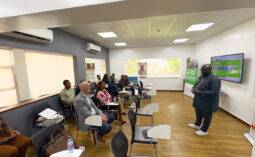
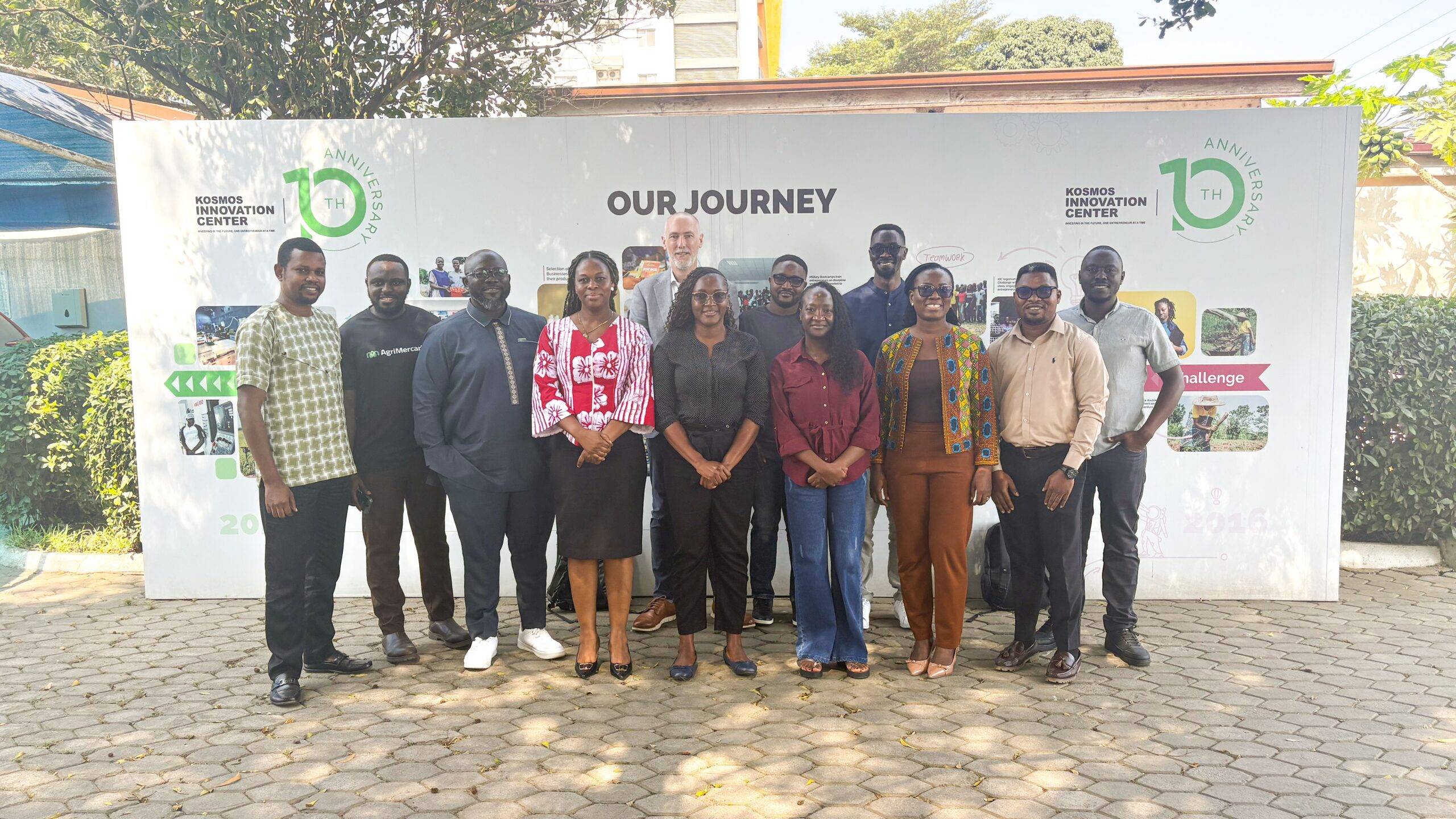
During a recent visit to KIC, the
Mastercard Foundation Team engaged with KIC and a number of youth-led
businesses supported through the Initiative for Youth in Agricultural
Transformation (IYAT). The visit provided an opportunity to see how supporting
entrepreneurship development can translate into businesses, jobs, innovation
and wider economic participation.
In his presentation, KIC
Executive Director Benjamin Gyan-Kesse highlighted KIC’s commitment to empowering
young entrepreneurs to see agriculture differently—not simply as a traditional
sector, but as an opportunity for innovation, technology, enterprise and social
impact.
The businesses that participated
in the engagement offered a practical view of what this transformation can look
like.
When Support Becomes a
Foundation for Growth
For Grow For Me, the KIC
journey began at an early stage of its development, in 2022 when it joined the
KIC incubation programme. Access to office space provided the young business
with a place from which to build, while KIC’s entrepreneurship and business
development support helped provide structure as the company developed its
model.
Over time, the business expanded
its networks, accessed financing and built a platform connecting farmers,
investors and buyers.
Today, Grow For Me has reached
more than 19,000 farmers across Ghana, using technology, financing,
aggregation and trading to support smallholder farmers. The company is also
listed by Ghana’s Securities and Exchange Commission as a licensed crowdfunding
intermediary.
Its growth illustrates an
important dimension of KIC’s approach: support for entrepreneurs is ultimately
about helping them build businesses capable of creating value beyond their own
organisations.
Turning Waste into Opportunity
For AgriMercarb, who also
joined the KIC Incubation Program in 2022, the challenge was different.
The company is developing
solutions around one of the agricultural economy’s persistent challenges: how
to turn waste into something valuable.
Using black soldier fly
technology, AgriMercarb transforms organic waste into products including
protein-rich inputs for animal feed, organic fertiliser and other useful
materials. Its current model is focused on establishing community-based
production facilities and working with communities to turn organic waste into
economic and agricultural value.
KIC’s support has contributed to
the business development journey, including support around business management,
financial reporting and record keeping.
The significance of the model
goes beyond the products themselves.
By decentralising production and
working with communities, AgriMercarb is exploring how agricultural innovation
can also create local economic opportunities while addressing environmental
challenges.
Its journey demonstrates how
young entrepreneurs can use technology and locally relevant innovation to
respond to problems within their own communities.
Making Urban Agriculture
Possible
For Farm Estates, the
challenge was how to produce fresh vegetables in an urban environment while
responding to concerns around land availability, climate conditions, water use
and food safety.
The company has developed an
indoor vertical hydroponic farming model that uses technology and controlled
environments to produce vegetables without conventional soil-based farming. Its
current model combines vertical hydroponics, automation and AI-enabled
monitoring to produce pesticide-free leafy greens and other vegetables.
Farm Estates joined the KIC
programme in 2021 and entered KIC’s incubation programme in 2022. Today, its
products are reaching supermarkets, malls and online grocery platforms, while
the company continues to develop its technology and explore more sustainable
approaches to energy and food production.
The journey also demonstrates
another dimension of entrepreneurship: solving one problem often creates the
opportunity to address another.
As Farm Estates has worked to
improve freshness and shelf life, it has developed new approaches to packaging
and distribution. The company has also explored smart hydroponics training,
sharing its knowledge with other farmers interested in climate-controlled
production.
Connecting Farmers to Finance
and Markets
For LbH, the opportunity
lies at the intersection of technology, finance and agriculture.
The company is building digital
solutions that connect smallholder farmers with agricultural service providers,
financing, inputs, agronomy support and markets.
LbH emerged from KIC’s AgriTech
Challenge Pro and Business Incubation programmes. The company connects
smallholder farmers with agricultural service providers through technology
while also helping farmers access premium markets.
Its reach has grown
significantly. LbH’s has supported more than 67,000 farmers through their
platform.
More recently, LbH has expanded
its approach to financial inclusion by developing a Buy Now, Pay Later model
for poultry and fish farmers, providing access to feed on flexible payment
terms.
The story of LbH shows how a
young Ghanaian technology company can use digital infrastructure to address
longstanding barriers to finance and services within agriculture.
Beyond the Business
The stories of Grow For Me,
AgriMercarb, Farm Estates and LbH are different, but they share a common
thread.
Each business started with an
entrepreneur identifying a challenge or opportunity. Each has had to navigate
uncertainty, refine its business model and build the capabilities required to
grow.
KIC’s role has been to help
create the conditions in which those entrepreneurs can develop.
Through entrepreneurship
training, coaching, mentorship, incubation, funding, physical infrastructure,
networks and ecosystem linkages, KIC works to ensure that young entrepreneurs
have access to more than a single intervention.
The goal is to help them build
the capabilities, relationships and businesses required to participate
meaningfully in Ghana’s agricultural economy.
That is central to the Initiative
for Youth in Agricultural Transformation, a partnership between the
Mastercard Foundation and KIC that seeks to equip young people with
opportunities for entrepreneurship, innovation and dignified work across
agriculture and related sectors.
The Mastercard Foundation team’s
visit therefore offered more than an opportunity to showcase successful
businesses. It provided a window into what happens when young people are given
the opportunity, resources and support to turn problems into solutions.
From farmers gaining access to
finance and markets, to communities finding value in organic waste, to urban
consumers accessing locally grown vegetables, the impact of youth
entrepreneurship can extend far beyond the businesses themselves.
At KIC, the ambition is not
simply to create businesses. It is to support young people to build businesses
that create value, generate opportunities and contribute to a more innovative,
inclusive and resilient agricultural economy.