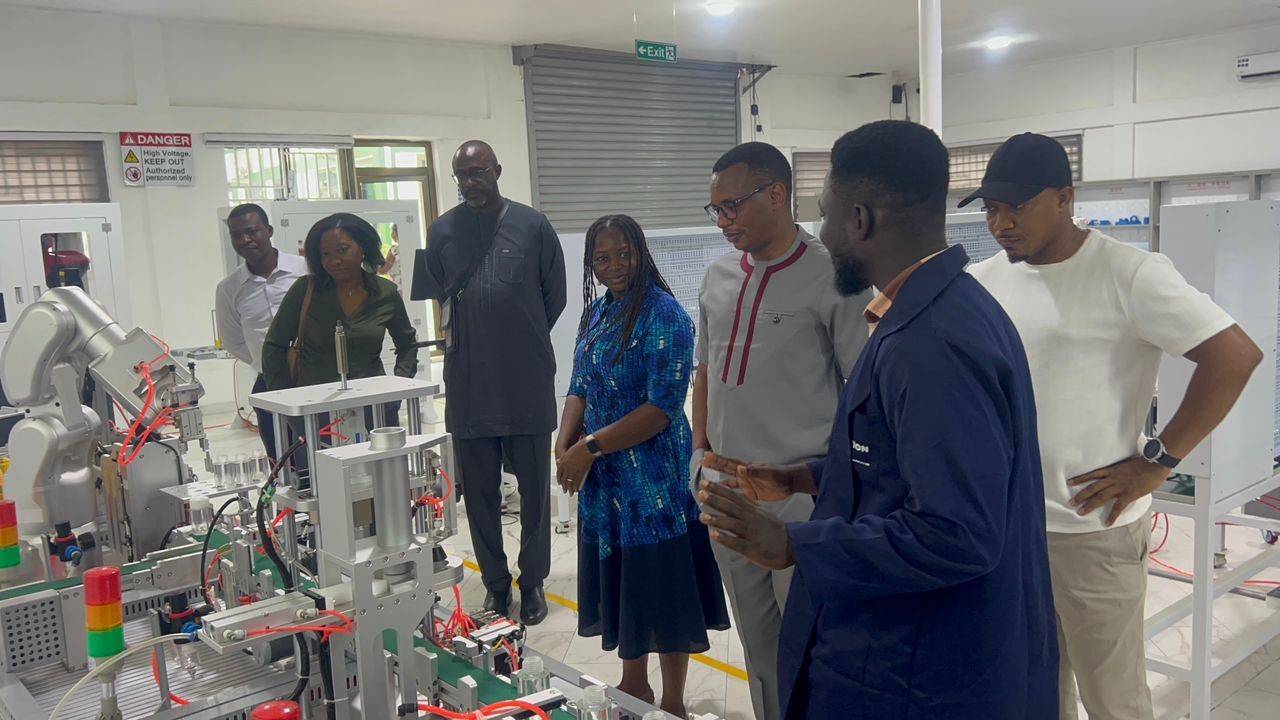
Mr. Paul Kasanga, the Mastercard Foundation’s Ghana Country Director recently visited the KIC Center of Excellence in Kumasi to see how the facility is advancing youth-led entrepreneurship under the Initiative for Youth in Agricultural Transformation (IYAT), a Mastercard Foundation programme implemented in partnership with KIC.
Established with support from the Mastercard Foundation, the KIC Center of Excellence gives young entrepreneurs access to the infrastructure and technical support needed for product design, development, fabrication and food innovation. By helping innovators move from an early idea to a working solution, the center strengthens an important part of the entrepreneurial journey.
During the visit, KIC demonstrated how the center is already translating ideas into practical outputs. It has supported start-ups in the KIC Incubation Programme to develop agro-machinery products and provided product-design support to students from KNUST, connecting entrepreneurial ambition and academic talent with the tools required to build and test solutions. Also 30 start-ups participating in this year’s AgriTech Challenge Pro are receiving technical coaching for agro-processing and machine fabrication.
The KIC Center of Excellence in Kumasi is a multidisciplinary innovation and prototyping hub supporting the development of practical, market-ready solutions across agriculture, manufacturing, engineering, construction, IT, energy, extractives and related sectors. Its cross-sector model creates opportunities to share equipment, expertise and learning across different groups of innovators.
Mr. Kasanga commended the centre’s progress in supporting youth entrepreneurship. He noted that access to this kind of infrastructure can help young innovators move more efficiently from concept to prototype and, ultimately, to solutions that can be produced at scale. The partnership also demonstrates how innovation hubs and universities can combine technical expertise, facilities and emerging talent to strengthen the pipeline of market-ready enterprises.
The visit reinforced the Center of Excellence’s role as a platform for innovation, practical skills development and enterprise support. As more young people and institutions engage with the centre, the model has the potential to expand the pipeline of locally designed solutions, strengthen collaboration between academia and industry, and help promising ventures progress towards wider market adoption.